

SC-500 Exam questions explained · Exam Q&A 1
5 SC-500 Identity and Governance Questions Explained
Five SC-500 exam-style questions on PIM, Conditional Access, app consent, managed identities and Key Vault, with the answer and the reason.

Identity, access and governance is 20-25% of the SC-500 exam. The questions are scenarios: a short story, four plausible answers, and one that fits best. Here are five from the course’s exam Q&A video, each with the reasoning and the Part to rewatch.
A four-step method for any scenario
- The need: what must the engineer achieve?
- The scope: one resource, a resource group, a subscription, or the whole tenant?
- Prevent or detect? “Prevent” points to Policy, guardrails or a firewall; “detect” points to Defender plans or Sentinel.
- Least privilege and least cost: of what remains, choose the smallest change that meets the need.
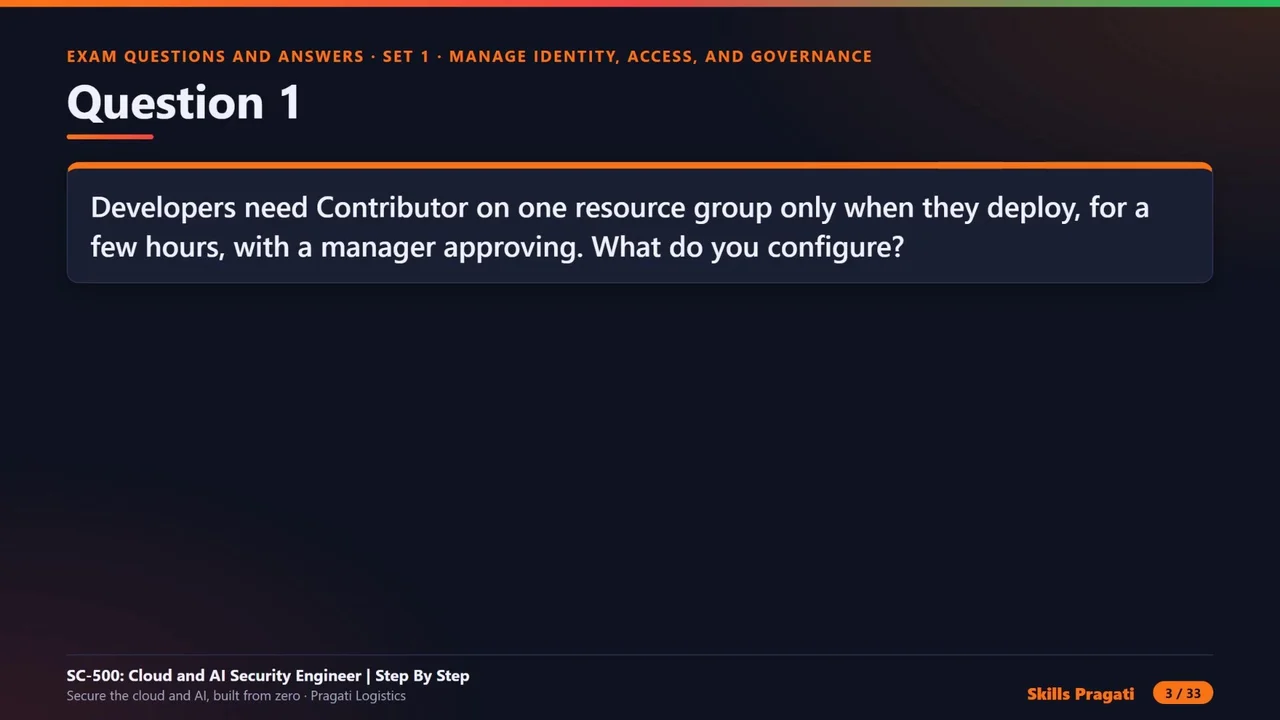
Question 1
Developers need Contributor on one resource group only when they deploy, for a few hours, with a manager approving. What do you configure?
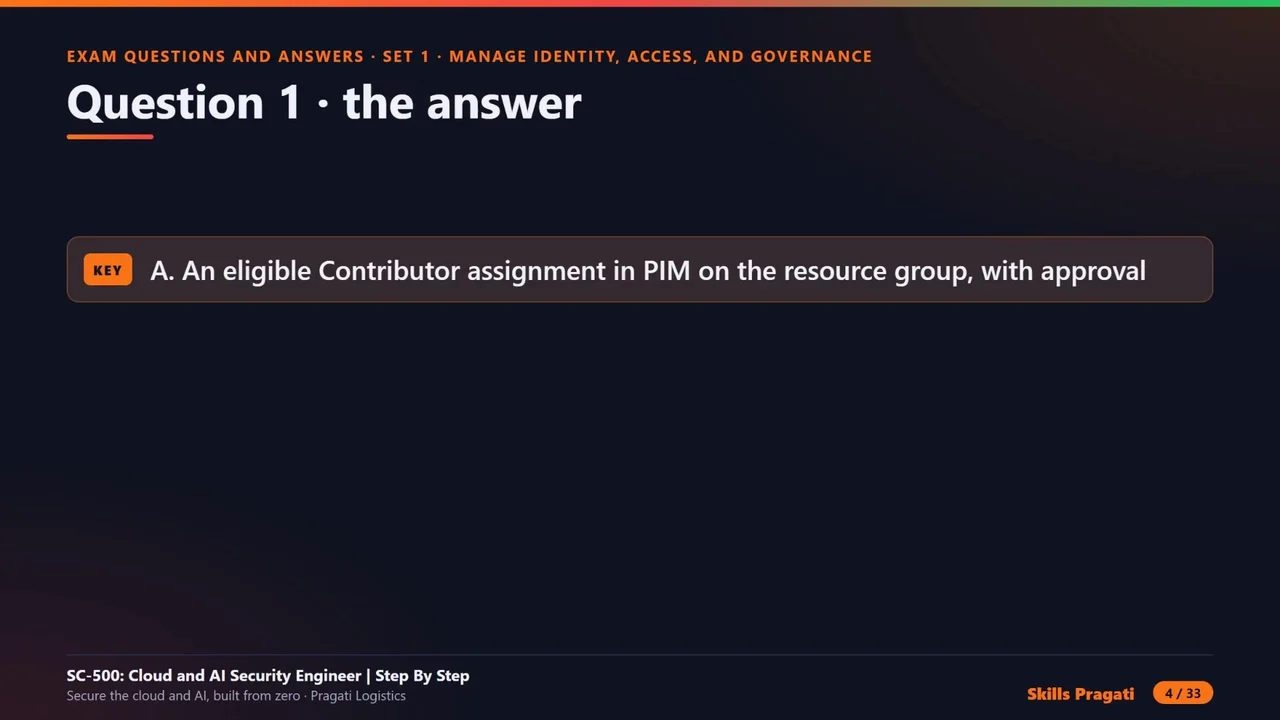
Answer: An eligible Contributor assignment in PIM on the resource group, with approval. PIM makes the role eligible, not active: activated for hours, with approval and MFA, scoped to the resource group, not the subscription. Rewatch: Part 1.
Question 2
Admins must sign in to the Azure portal and CLI with a passkey or Windows Hello, never a password and SMS. Which Conditional Access grant?
Answer: Require authentication strength: phishing-resistant MFA. Require MFA accepts any second factor, including SMS. Phishing-resistant strength allows only passkeys, Windows Hello and certificates. Target Azure Resource Manager. Rewatch: Part 1.
Question 3
Users keep granting unknown apps access to their mail. Every consent must go to a named reviewer. Which two settings?
Answer: Do not allow user consent, and turn on the admin consent workflow with reviewers. With user consent off, nobody grants permissions alone; admin consent requests let users ask and a reviewer decide. Rewatch: Part 1.
Question 4
An app on an Azure VM needs a Key Vault secret, and no credential may be stored anywhere. What do you use?
Answer: A managed identity with the Key Vault Secrets User role. A managed identity has no secret to store or rotate: Azure owns the credential. Secrets User is read-only. Rewatch: Part 2.
Question 5
An attacker with Owner rights must not be able to permanently destroy Key Vault keys. What do you enable?
Answer: Purge protection. Soft delete keeps deleted objects, but an admin could purge them. Purge protection blocks purging until the retention ends, for everyone, and can never be turned off. Rewatch: Part 2.
Practise the rest
The full video walks through every question in this domain. For timed practice with a score per domain, take the SC-500 mock exam, and rewatch the Parts it points you to.
Do it yourself
- The full SC-500 courseEvery Part, free on YouTube, in order
- Hands-on lab guideThe exact steps, what it costs, how to clean up
- Practice simulationRehearse every click in your browser; the first lab is free
- Mock examFree 10-question sample, then the full timed mock scored by domain
Lab guides, practice and full mock exams come with a subscription. See the plans